Understanding Eisbein: The Classic Cut and Its Modern Makeover
The German Pork Knuckle: A Flavor and Texture Profile
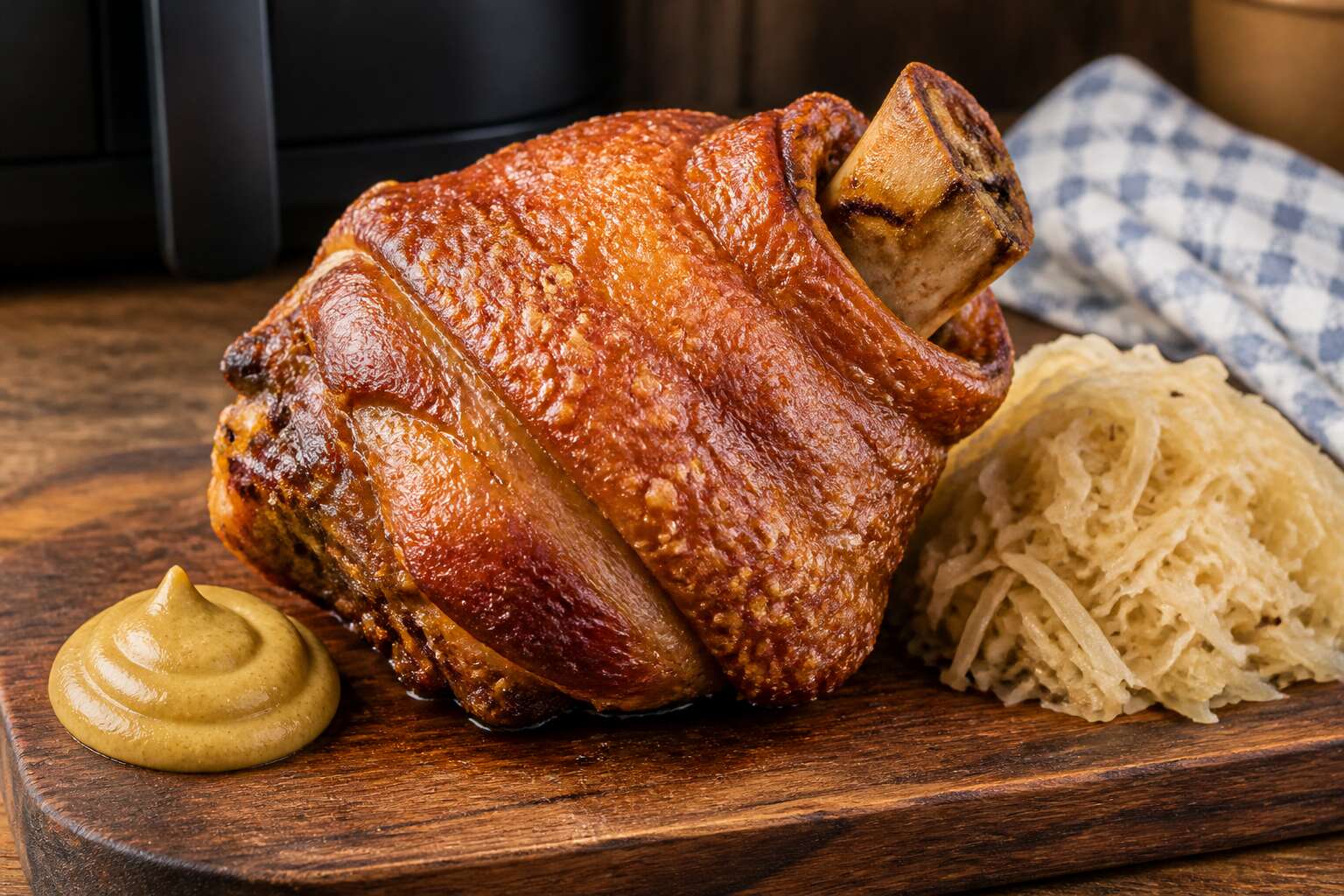
South Africans know their braai, yet the German Eisbein holds a separate tradition. This celebrated cut, taken from the pig’s lower leg, combines a formidable layer of collagen with a stubborn bone that demands respect. Traditionally boiled or roasted for hours, it yields a gelatinous interior and a crackling exterior that rewards patience. The airfryer eisbein shifts the approach.
Flavour leans into the umami spectrum, with a saline depth derived from the curing process. Texture offers three distinct sensations: the shattering skin, the tender muscle, and the slippery marrow within the bone. For the home cook, the modern makeover means less vigilance. No basting, no oven-watching. Just a predictable result. Preparing an airfryer eisbein requires only a patient hand and a meat thermometer.
The markers of a prepared knuckle include:
- A thick layer of subcutaneous fat
- Skin that remains intact and hydrated
- A pale pink muscle tone without dryness
Traditional Braising vs. Air Frying: What Changes
For generations, the German kitchen treated the eisbein as a commitment. A raw knuckle went into simmering stock or onto a roasting tray, and it stayed for hours. Braising softens the collagen and builds that character. The airfryer eisbein method compresses the timeline. Dry heat circulates at high velocity, which changes the process entirely.
Traditional braising uses moisture to conduct heat. The meat steams in its own juices, protecting the fibres but dulling the skin. Air frying removes that barrier. Hot air hits the surface directly, drawing moisture from the rind and turning it brittle. The interior still reaches the safe temperature, but through a shorter path.
That shift creates a few variables worth tracking. I keep an eye on:
- Internal temperature at the thickest point of the muscle
- The skin, which should blister without charring
- The size of the piece, since a heavier knuckle needs extra minutes
That is the real difference. Braising forgives a stray glance at the clock. The airfryer eisbein gives you a distinct window, and then it closes.
Choosing the Best Pork Knuckle Cut for Your Air Fryer
A pork knuckle is not a passive cut. It carried the animal’s weight for months, so the meat sits beneath a stubborn layer of collagen and sinew. That is why the airfryer eisbein method suits this cut so well. The front leg, properly called the eisbein, offers a better skin-to-flesh ratio than the rear hock. The rear provides more visible meat, but the front provides a rind that crisps and an interior that stays moist.
When I choose a knuckle for the air fryer, I look for:
- Unblemished skin, still attached at the edges
- A weight between 800 grams and 1.2 kilograms
- Firm, pale flesh with clean white fat
Size dictates the cooking window. A heavier knuckle pushes the total time upward, and the skin may dry before the centre reaches temperature. The modern makeover of this classic cut depends on that balance. Choose well, and the airfryer eisbein delivers a crisp rind with a tender interior in under two hours.
Preparing Your Pork Knuckle for Air Fryer Success
Brining and Marinating: Unlocking Deep, Savory Flavor
A pinch of salt barely touches the surface, but a proper brine rewires the entire structure. I’ve found twelve hours in a 4% saline solution with juniper and bay yields the deepest savory notes. The collagen relaxes, the muscle fibers absorb seasoning, and the meat turns tender without losing character. For a successful airfryer eisbein, this step is non-negotiable.
After brining, pat the pork knuckle dry. Apply a dry rub of coarse salt, caraway, and garlic powder. Leave it uncovered in the fridge overnight. That air exposure forms a sticky pellicle, which dries the skin and promotes an even crackle under circulating heat. The result is a deeply seasoned interior and a crust that shatters.
Drying and Scoring the Skin for Perfect Crackling
The crackling is the proof of a properly prepared airfryer eisbein. After brining and the overnight pellicle, the skin needs targeted scoring to render fat and create those crisp ridges. A dry surface is essential. Moisture prevents crackling. Use paper towels to absorb any residual dampness, especially around the bone and creases.
Score the skin in a diamond pattern with a sharp blade, cutting just through the fat, not into the muscle. The cuts should be about two centimeters apart. This allows steam to escape and heat to penetrate evenly. Without scoring, the skin tightens and blisters instead of crackling.
- Parallel cuts for a classic look
- Diamond crosshatch for more surface area
- Vertical slits along the bone for even rendering
The scoring depth changes the texture. Shallow cuts produce a thinner crackle; deeper cuts expose more fat to the circulating heat, which accelerates crisping.
To Pre-Boil or Not: The Shortcut Debate
Pre-boiling splits the crowd like few other steps in the airfryer eisbein routine. Some swear a thirty minute simmer softens the skin before the basket ever gets involved. Others insist boiling washes out the salt and spice from brining. Both camps speak from real results.
I have taken the shortcut myself. The pre-boiled knuckle renders fat faster, and the crackling still comes out crisp. But the meat gives up some of that deep brined character. Cooking from raw keeps every bit of flavour locked inside. The extra waiting rewards you with a truer taste.
Essential Seasoning Blends That Complement Pork
Once the knuckle is dry and scored, the seasoning carries the flavour. Pork pairs well with bold, aromatic spices. A South African blend starts with crushed coriander, black pepper, and caraway. Rub the mix deep into the scored cuts and over the whole surface.
Some home cooks add a little brown sugar or honey to the skin. It caramelises in the basket and hardens the crust.
- coriander seeds
- caraway seeds
- black peppercorns
- smoked paprika
- garlic powder
A seasoned knuckle rests in the fridge for an hour, uncovered. The dry chill tightens the skin before the airfryer eisbein finishes the job. The crackling shatters and the meat tastes deeply of its marinade.
Mastering the Air Frying Process for Tender Meat and Crispy Skin
Starting with High Heat: Sealing in the Juices
At 230°C, the pork knuckle skin begins sizzling within seconds of hitting the basket. That burst of heat forces the subsurface collagen to soften while the exterior tightens, creating the foundation for proper crackling. Skip this stage and the fat never renders; you are left with a chewy, grey finish.
The first ten minutes demand close attention:
- Blistering across the skin signals moisture escaping
- Fat dripping onto the element causes a faint wisp of smoke
- Colour shifts from pale to a deep amber
I keep the drawer shut during this window. Opening it releases the accumulated heat and stalls browning. Patience rewards you with a crust that fractures under the knife and meat that releases cleanly from the bone. That is the airfryer eisbein done right!
Lowering the Temperature for Slow, Even Rendering
After the searing heat, the airfryer eisbein needs a gentler hand. Dropping the temperature to 160°C allows the thick pork knuckle to render slowly. The fat softens, moisture pushes deeper into the meat, and the skin stays crisp without charring. I let it run for forty minutes, checking only once.
The interior transforms from tough to tender. That slow cook releases gelatin, giving the meat a silky bite.
Keep these rhythms:
- Turn the basket at the halfway point
- Listen for a steady crackle
- Resist opening the drawer
The crackling holds its shell while the inside falls apart. That is the balance every airfryer eisbein aims for.
The Art of Basting and Flipping for Uniform Crust
Two forces decide the fate of an airfryer eisbein: the fan’s swirl and the brush’s sweep. Basting requires attention. Each stroke lays a thin film of rendered fat over the skin, and that film blisters under heat into a uniform crust across the knuckle. I baste twice in the first fifteen minutes, while the fat is liquid and the surface receptive.
Flipping the meat itself, not merely the basket, catches the hidden spots. The underside of the airfryer eisbein sits in its own juices, staying supple while the exposed side hardens. A quick turn swaps those roles, and both sides reach the same crackle.
- Early basting seals the scored lines
- Midway flipping moves the raw face upward
- Final basting locks the crust
Listen for the crackle. Without the baste, the heat dries the skin out. Without the flip, half the knuckle arrives soft and pale. The crackle confirms the crust!
Final High-Temperature Blast for Extra Crunch
The final high-temperature blast is the difference between a good airfryer eisbein and a great one. You have rendered the fat, basted with discipline, and flipped with care. The meat beneath is tender, practically yielding. But the skin, while crackled, still holds a hint of chew. This is where the heat takes its last stand.
Crank the dial to 200°C. Give it four to five minutes. Watch it, because the line between crackle and char is thin. The remaining moisture in the skin vaporizes instantly. The fat you have carefully layered on now hits its smoke point. It puffs. It blisters. It snaps.
The physics of the blast are simple:
- The high heat evaporates the last droplets of surface moisture
- The rapid expansion of fat cells creates a brittle, glassy shell
- The short duration protects the tender meat underneath from drying out
The airfryer eisbein emerges with skin that shatters audibly. The interior stays supple. You do not need to rest it, you need to carve it. The fan spins down, and the kitchen fills with that final, clean aroma. Timing remains your only measuring stick; pull it too late and the bitterness of burned fat takes over. Pull it too soon and you are left with a faint rubbery resistance. Trust the sound. When it shatters under a gentle fork tap, the journey is complete.
Resting, Carving, and Serving the Perfect Knuckle
There is a specific silence in the kitchen after the airfryer eisbein finishes its final blast. Not a restful silence. The quiet of a pending ceremony. The meat has surrendered, the skin has turned glassy, and the knuckle now waits for the intervention of a blade.
Resting here is an unnecessary ritual. Forget the towel tent and the ten minute wait. The structure holds firm. What demands discipline is the cutting. Follow the bone, not the urge to stab. The flesh parts, the crackle fractures, the steam rises. A sharp knife matters. A dull one grinds the crust into crumbs.
- A blade long enough to reach the joint in one stroke
- A board with a moat for the juices
- The self control to serve before sampling
Serve the knuckle whole or carve it into rough slabs. The airfryer eisbein asks for an audience that understands crunch is a promise kept.
Troubleshooting Common Air Fryer Eisbein Pitfalls
Avoiding Tough or Chewy Meat: Time and Temperature Fixes
The airfryer eisbein turns tough when the temperature stays high for the entire cook. Collagen requires a gentle, prolonged heat to dissolve into gelatin. Set the fryer to 130°C after the crust forms, then hold it for forty minutes. The meat should yield to a fork without resistance.
Cooking times vary with the weight of the knuckle.
- Under 1 kg: thirty five minutes at low heat
- Over 1.5 kg: fifty minutes or more
Watch the internal temperature. Pork should reach 90°C for tender fibres. If it stalls around 75°C, give it time. Rushing the process guarantees a chew.
Preventing Uneven Browning and Blistered Skin
A pale, mottled rind on an airfryer eisbein is a kitchen failure that lingers! The crust should be uniform amber, cracked in fine lines, and taut over every centimetre. Blisters form when water sits trapped beneath the scoring. The heat turns it to steam, lifting the skin into a pocket that scorches before the rest colours.
Uneven browning, I have learned, follows the fan. The side facing the heating element dries and darkens while the opposite side stays anaemic. Rotating an airfryer eisbein every fifteen minutes, keeping it centred in the basket, fixes most of that.
- Score cuts spaced too far apart leave sheets of skin that bubble
- An overcrowded basket blocks airflow on the contact side, leaving it pale
- Oil pooling in the crevices fries the skin into blistered welts
Managing Smoke, Splatter, and Messy Cleanup
The first time I cooked an airfryer eisbein, the smoke alarm joined in halfway through. Fat renders, and it spits. A little water in the base tray helps, but not too much. Steam softens crackling. The splatter lands on the heating coil and burns, which creates that acrid haze.
Common culprits for the haze:
- Excess fat left thick in one spot
- A sugary glaze dripping before the final blast
- Starting too cold, so fat pools before it renders
Line the basket with foil, but leave the edges open so air can move. A splash guard helps, though I rarely use one. Cleanup has its own rhythm. Soaking the basket while the meat rests lets the grease lift away, and bicarbonate and hot water cut through without scouring the coating.
Adapting Recipes for Different Air Fryer Models and Sizes
Every air fryer interprets heat differently. A compact basket model circulates air with more aggression than an oven-style unit, so your airfryer eisbein may need ten extra minutes in one machine and ten fewer in another. Wattage changes everything. A high-powered unit renders fat quickly, while a lower wattage model demands patience and a gentler starting temperature.
Overcrowding is the most avoidable pitfall. When the knuckle presses against the basket walls, hot air cannot reach the scored skin, leaving a pale patch that never crisps. Rotate the meat twice. If your model has a rotating spit, use it. Manual flipping also works. Check calibration. A 200°C dial might deliver 180°C in reality, which explains a soft crust on the airfryer eisbein.
- Smaller baskets suit knuckles under 1.2 kilograms. Anything larger blocks airflow.
- Oven-style models need longer preheating. Add five minutes before the meat.
- Keep a probe thermometer near the basket.
Serving Suggestions and Flavor Pairings for Your Eisbein Feast
Classic German Sides: Sauerkraut, Potato Salad, and More
The airfryer eisbein lands on the plate with crackling skin and tender meat. The right sides turn this into a proper feast, and classic German pairings work because they balance the richness without fighting for attention.
Sauerkraut delivers sharp acidity that cuts through the pork fat. Potato salad, whether creamy or vinegar based, adds comforting heft. For a complete spread:
- Sauerkraut simmered with juniper berries
- German potato salad with bacon and warm vinegar dressing
- Fresh grated horseradish blended with cream
- Dark rye bread slathered with whole grain mustard
Serve the airfryer eisbein with a cold lager or a dry riesling. The bubbles and acidity refresh the palate between bites. Simple, honest sides let the star of the show shine.
Mustards, Horseradish, and Signature Sauce Pairings
The airfryer eisbein’s crackling crust demands condiments that match its boldness. A sharp wholegrain mustard cuts through the fat, while a sweeter Bavarian mustard offers contrast. Fresh horseradish, grated and mixed with cream, brings sinus clearing heat. For a signature sauce, simmer apple cider vinegar with a touch of honey and caraway seeds until syrupy. This adds tangy sweetness without masking the pork. Consider these pairings for your next plate:
- Spicy brown mustard with a splash of beer
- Creamed horseradish and chives
- Honey caraway glaze
Each element should complement, not overwhelm. Let the airfryer eisbein remain the centrepiece of your table.
Choosing the Right Beer or Beverage to Complement the Dish
Some meals demand a beverage that holds its own. A good airfryer eisbein, with its crackling skin and rich fat, will overwhelm a timid beer. Seek out something with enough carbonation and bitterness to refresh the palate between bites. A Czech pilsner offers a sharp, noble hop bite, while a Munich helles provides a softer, malty sweetness.
For drinkers who want variety, a Belgian witbier adds orange peel and coriander, which brighten the palate between bites. Carbonation must be lively. I have yet to meet a witbier that disappointed.
For those avoiding alcohol, a strong rooibos iced tea with a squeeze of lemon brings tannic structure. Sparkling water with lime does the same job, quietly and without ceremony!
- Czech pilsner for crisp counterpoint
- Munich helles for gentle malt sweetness
- Belgian witbier for citrus and spice
Each pour should respect the centrepiece. The airfryer eisbein leads, and the glass merely follows.
Creative Leftover Ideas: Reinventing Cold Eisbein
Hot from the basket, the airfryer eisbein demands to be carved at the table. I serve it on a thick wooden board with its own juices pooled beside it. Guests pull at the meat with forks, chasing the crisp shards of skin before they cool.
Once cold, the leftover meat takes a different direction. Shred it and crisp in a dry pan until edges brown and curl. Pile it onto buttered rye with a slick of wholegrain mustard and a handful of watercress.
- Pair cold slices with fresh apple, sharp cheddar, and a drizzle of honey
- Use shredded meat in a hearty fried rice with garlic and spring onion
- Fold chunks into a lentil soup for added depth
The original airfryer eisbein, however, rewards immediate attention. Let the crackling linger and it turns stubborn.
Plating and Presentation Tips for Holiday or Special Occasions
Plating a holiday eisbein is about timing. The first crackle of the skin under the knife tells you the airfryer eisbein is still brittle and warm. Arrange the knuckle on a wide wooden board with the scored lines facing up. Pool the resting juices beside it, not over the skin, so the crackling stays sharp.
Certain pairings make the meat taste bigger. Think sharp and acidic against the richness:
- A spoonful of wholegrain mustard cut with honey
- Quick-pickled red onion and apple
- A vinegar-heavy chakalaka for a South African edge
Each contrast cleanses the palate between bites.
Keep the board uncluttered. A scatter of fresh thyme, a few shards of sea salt, and nothing else. The meat sits at the centre, unadorned. Guests carve at their own pace, and the aroma fills the room.


0 Comments