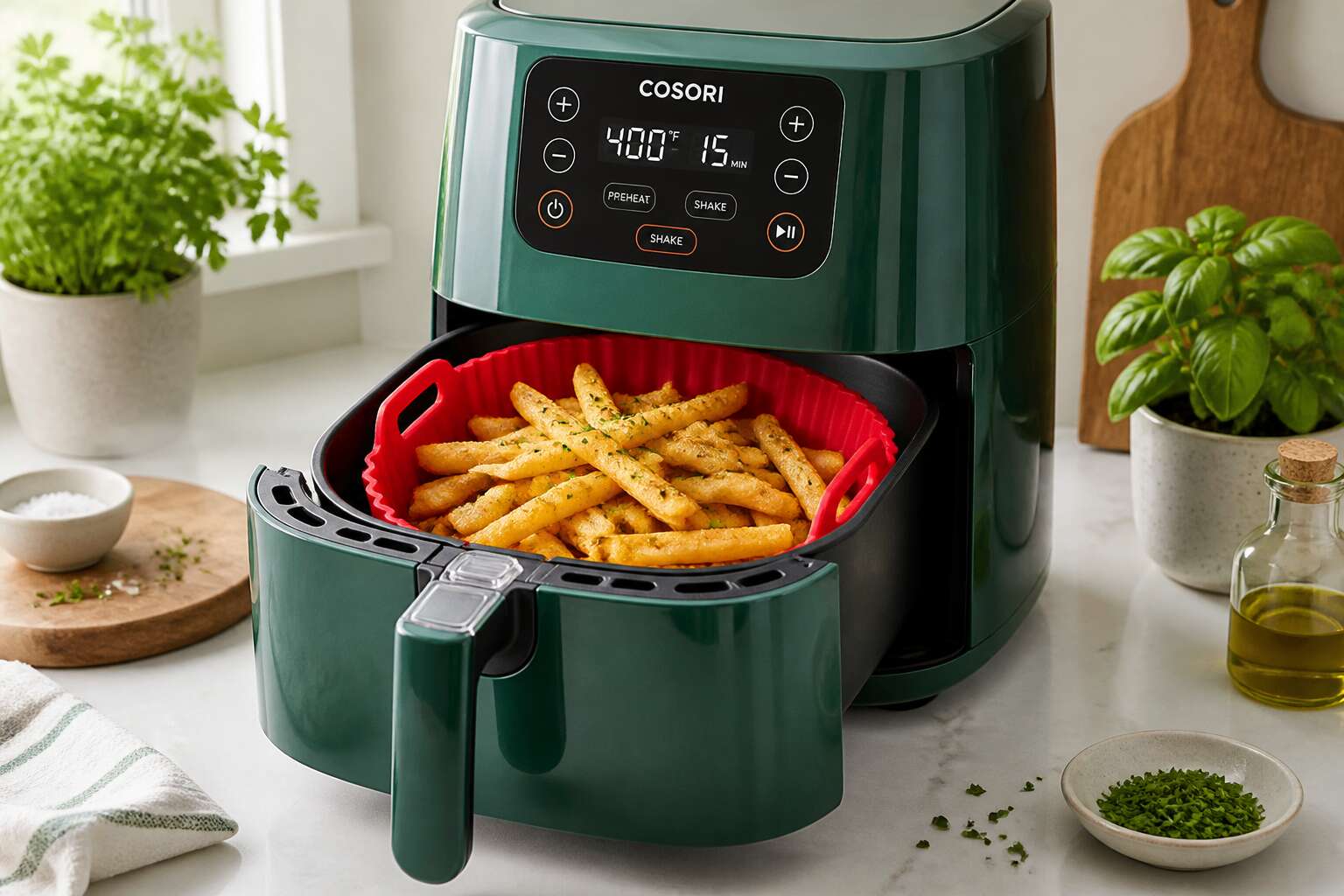
Understanding Silicone Air Fryer Liners
Definition and How They Work
An air fryer’s heating element pushes temperatures past 200°C, and silicone liners take that stress without degrading. An airfryer silicone basket liner is a molded sheet that sits between your meal and the metal basket. This barrier changes how heat and moisture interact with food.
The liner works by reflecting dry heat while capturing oils that drip from meat or vegetables. Its non stick surface releases food without grease. Your meal retains moisture, and the basket stays free of burnt residue.
- The thin profile preserves air circulation for crispness.
- The raised edges catch surplus fat.
- The material flexes to fit various basket shapes.
For South African kitchens, where load shedding disrupts preparation, these liners cut cleaning time. An airfryer silicone basket with a liner is a practical layer of protection, not a cooking ritual!
Different Shapes and Designs Available
Not every airfryer silicone basket liner looks the same. Round liners match the bucket style baskets on many entry level machines. Square liners fit the drawer style units. Some liners are shallow discs. Others rise with contoured walls, forming a shallow tray that catches crumbs and drips. Perforated panels let hot air reach the underside of food, while solid versions hold marinades and wet batters.
Here is the standard lineup.
- Round and square fitted liners sized to specific basket capacities
- Universal sheets that you trim down with kitchen scissors
- Deep bowl liners for saucy or steam heavy meals
- Flat discs for reheating pastries or cooking frozen snacks
The variety matters more than it seems. A liner that barely fits will fold and bunch. One that hangs over the edge can touch the heating element. The wrong profile is the difference between a quick scrape and a soaking session.
Material Composition and Food-Grade Standards
Food-grade silicone sounds reassuring, but the label hides a spectrum of quality. The best liners use platinum cured silicone, free from the fillers and peroxides that cheapen lesser products. These fillers can leach odours into your meal and, over time, break down into a sticky mess. A genuine airfryer silicone basket should feel dense, bounce back when pinched, and survive a hard twist without whitening.
Standards matter more than marketing. South African shoppers should look for LFGB certification, Europe’s stricter cousin of FDA approval. LFGB testing checks migrating substances far more rigorously. Some local brands carry SABS marks, but verify the claim. A certified airfryer silicone basket holds up to repeated heating without warping or releasing compounds.
- Platinum cured silicone for thermal stability
- LFGB or FDA certification as proof of purity
- No fillers, no painted coatings, no hidden layers
Price often signals composition. A liner priced like a fast food meal likely contains cheap extenders. You want a tool that performs like a kitchen workhorse, not a novelty item that fails on the third roast.
Reasons to Switch to Silicone Liners
Effortless Cleanup and Non-Stick Surface
A single fried chicken session used to mean twenty minutes of scrubbing. That ended with a silicone liner. The non-stick surface lets every crumb lift away clean. You just pull out the liner and wipe it under warm water. No greasy mornings, no burnt patches that stay put.
- No need to soak the basket overnight
- No scratching tools required
- Your airfryer silicone basket remains spotless between cooks
The liner catches every drip and splatter. This simple addition saves real time in a busy Johannesburg kitchen. You cook, serve, and clean in under a minute. That is the effortless part, and the non-stick quality guarantees it.
Enhanced Heat Distribution and Cooking Efficiency
Air circulation determines whether chips crisp evenly or come out patchy. A well perforated silicone liner does not block that flow. It holds food in place while hot air moves around each surface, so pieces cook at the same pace. The result is a consistent golden batch without pausing to rearrange.
The metal basket heats quickly, but food touching bare metal can scorch. The silicone creates a thin, even barrier that moderates that contact. Heat settles in gently, which works well for frozen items. It also reduces the need for extra oil because nothing clings to the surface and burns.
– Wide perforations allow maximum airflow
– Tight perforations require an occasional shake
– Thin liners transfer heat better than thick ones
The right airfryer silicone basket balances airflow and coverage. That balance shortens cook times and keeps texture uniform from first batch to last. Choosing an airfryer silicone basket with even perforation ensures you get that efficiency without losing crispness.
Safety and Durability Factors
I have seen what happens when a metal basket coating starts breaking down. Tiny flecks end up in the food, and nobody notices until the taste changes. An airfryer silicone basket does not chip, peel, or rust. That alone is reason enough to switch, especially when load shedding interrupts a cycle and food sits longer than planned.
The safety story extends further. High grade silicone tolerates temperatures well above what your airfryer produces. It stays stable, releases no fumes, and does not warp from repeated heating and cooling. That durability lets the liner outlast metal accessories.
Reasons to switch:
- No metal scratching of the basket coating
- Flexible sides lift food out in one motion
- Dishwasher safe without degrading
Some liners feel flimsy at first. The good ones hold their shape after hundreds of cycles, and that is the real durability test. Choose a thick food grade airfryer silicone basket and it will hold up.
Compatibility with Various Air Fryer Models
Most air fryers share a similar circular footprint, yet brand differences matter. The airfryer silicone basket bends to fit basket sizes from 2 to 6 litres, which covers popular models from Philips, Tefal, and Tower. That flexibility means one liner often serves several appliances, so a household with two fryers can swap them freely.
A few models have oval baskets or square corners. The silicone follows that contour too. For those who own a large family fryer, a bigger liner sits neatly inside without covering the heating element.
- Check the diameter before ordering
- Measure the basket depth
- Confirm the liner does not block the fan
These measurements take a minute and prevent the frustration of a liner that folds into the fan. Once fitted, the airfryer silicone basket works quietly with the machine’s existing settings. That is a simple compatibility win!
Cost-Effectiveness Over Time
Spending R50 a week on disposable liners feels harmless. That is R2 600 a year, a real figure in any South African grocery budget. A single airfryer silicone basket costs a fraction of that and survives hundreds of cooking sessions. The purchasing pattern changes from constant reordering to one deliberate outlay.
Silicone does not tear, absorb grease, or curl at the edges. It endures the same heat, then washes clean for the next meal. The cost per use decreases with every batch of chicken, chips, or roasted vegetables. There are no hidden replacement cycles, no monthly 20 pack reorders.
Consider the typical disposable spend:
– Parchment sheets: R40 monthly
– Foil trays: R55 monthly
– Paper basket liners: R35 monthly
Total that and the airfryer silicone basket recovers its purchase price within six weeks. Most households never calculate that figure, which is exactly why the recurring cost persists.
Selecting the Ideal Silicone Liner for Your Cooking Needs
Measuring Your Air Fryer’s Interior Dimensions
Your air fryer’s interior has exact dimensions. Measuring it before you buy a silicone liner prevents the annoyance of a sagging basket. Grab a tape measure and record the inner floor’s diameter or length and width. Also check the side wall height, because a liner that stands too tall will block the heating element and cause uneven cooking.
- Measure the basket’s inner floor.
- Measure the side wall height.
- Subtract 1 cm from each dimension for airflow.
With those numbers, selecting the ideal silicone liner becomes straightforward. A snug fit works wonders; a loose one flops around and a forced one warps. Match the liner’s shape to your model’s specific quirks, whether round, square, or oval. That airfryer silicone basket should sit stable, allowing hot air to circulate freely. Your future crispy chips will thank you.
Evaluating BPA-Free and FDA-Approved Materials
The quiet anxiety of choosing a liner for your airfryer silicone basket is real. Many shoppers trust labels blindly, yet certification remains the only safeguard. BPA-free and FDA-approved materials are not mere marketing whispers; they define chemical stability under heat. I always inspect the silicone’s polymer structure, seeking that inert quality. In South Africa, heat exposure is relentless, making this scrutiny vital!
- Explicit FDA registration number
- Independent lab testing results
- Transparent manufacturer sourcing
Without them, a liner may leach volatiles into your meal. The ideal airfryer silicone basket resists warping, holds its form, and releases food without theatrics. Choose one that carries verified safety credentials.
Considering Handle Designs and Ease of Removal
Reaching into a hot appliance after cooking is never pleasant. The handle of your airfryer silicone basket determines whether you lift with confidence or fumble. Look for moulded grips that extend beyond the rim.
Removal ease depends on more than the handle. A flexible structure that collapses slightly during lifting reduces suction against the basket walls. Some designs include small tabs for a pinch point. The best liners release their grip when tilted.
- Cool handles after cooking
- Reinforced edges
- Angled grips
I have tested liners where the handle felt flimsy. That weakness transfers directly to your wrist. A well designed liner feels substantial yet remains lightweight.
Comparing Single vs. Multi-Pack Options
One liner rarely survives a week of heavy air frying. That is why the choice between single and multi-pack options for your airfryer silicone basket deserves scrutiny. A single liner works for the occasional cook. Multi-packs suit those who run the appliance daily.
With several liners, you rotate them between batches. That reduces downtime.
- Batch cooking proteins and vegetables
- Accommodating different basket depths
- Sharing between multiple air fryers
The cost per unit drops with a multi-pack. Yet storing extras takes space. The right choice depends on your usage patterns.
Best Practices for Using Silicone Accessories in Hot Appliances
Correct Placement and Preheating Tips
Most cooking failures happen before the food ever goes in. The position of an airfryer silicone basket inside the hot cavity determines heat distribution and material longevity. Placement near the heating element exposes the silicone to concentrated radiant heat, which accelerates fatigue. Centering the airfryer silicone basket keeps airflow symmetrical, allowing the fan to reach every side of the food.
Preheating introduces another dynamic. Thermal shock occurs when a cold basket meets a preheated chamber at full temperature. The silicone expands unevenly in those moments, so gradual temperature exposure matters. South African households often face power interruptions mid-cycle, meaning the basket returns to a partially cooled appliance, then reheats. That fluctuation tests resilience more than steady, consistent heat.
The basket and appliance share a relationship of mutual accommodation. I have found that proper positioning and temperature pacing extend the lifespan of both components.
Recommended Cooking Temperatures and Times
Most airfryer silicone basket models tolerate heat up to 230°C, but that limit is not a daily target. For cakes and egg bites, set the temperature between 160°C and 180°C. Roasted vegetables cook well at 190°C. Meats handle 200°C, though shorter cycles reduce stress on the silicone.
Time follows the same logic. I stick to shorter windows for small items and extend them for dense batters. A practical reference:
- 10 to 12 minutes for mini muffins or small egg cups
- 15 to 20 minutes for chicken pieces or fish fillets
- 25 to 30 minutes for banana bread or casseroles
South African load shedding interrupts cycles often. If the basket cools halfway through, resist the urge to boost the temperature once power returns! Gradual reheating protects the airfryer silicone basket from uneven expansion. Your food stays consistent, and the accessory avoids premature wear.
Cleaning Methods for Long-Lasting Use
Between a golden batch of muffins and a failed batch, your airfryer silicone basket needs proper care. Load shedding disrupts cycles, but cleaning is where silicone accessories reveal their weaknesses. Cool the basket before washing. Hot silicone under cold water invites warping. A soak with soap and a soft sponge handles most residue. Stay away from abrasive brushes. They leave micro scratches that trap flavours.
For stubborn oil films, use a baking soda paste or white vinegar rinse. Then dry thoroughly. Moisture lingering in seams encourages mould. Your airfryer silicone basket rewards a weekly deep clean.
Here is a maintenance sequence:
- Remove crumbs after every use.
- Wash with warm soapy water.
- Rinse and air dry.
- Store flat to keep shape.
Silicone is resilient, but it does not forgive neglect. Scrub hard, and you shorten its life. Handle the accessory with patience, and your future baked goods will thank you.
Storage Solutions to Maintain Shape
Your airfryer silicone basket survives high heat, but storage decides its long term shape. Crumpling it into a drawer is a mistake. The silicone folds, creases form, and these creases become permanent weak points. Store it flat or hang it by the handle. Stacking heavy pans on top distorts the walls over time.
For hot appliance use, your airfryer silicone basket handles normal convection heat without issue. Keep it away from direct flame or bare heating elements. Silicone tolerates oven heat, but contact with a metal coil pushes it past its limits. Avoid sudden temperature swings. Let the basket adjust to room temperature before placing it on a cold counter.
A simple system works:
– Give the basket a dedicated spot, not buried under other cookware.
– Insert a paper towel inside to absorb lingering moisture.
– Check the shape monthly by setting it on a flat surface.
Storage discipline keeps your airfryer silicone basket true to form.
Avoiding Common Pitfalls with Silicone Air Fryer Inserts
Overfilling and Its Impact on Airflow
Overfilling an airfryer silicone basket compresses the space where hot air must move. That movement creates crispness. Without it, food steams instead of searing, and the texture turns soft and uneven.
Each piece needs room to circulate properly. When you crowd the basket, airflow stalls, prolonging cooking times and producing patchy browning. I have watched simple meals lose their quality through this single mistake.
The common consequences include:
- Longer cooking times
- Patchy browning on the surface
- A soft, soggy texture throughout
Using Metal Utensils and Sharp Objects
Metal tongs and steak knives seem harmless, but they leave lasting damage on a silicone liner. A single scrape can create a groove where oil pools and cleaning becomes harder. I have seen people ruin a perfectly good airfryer silicone basket in one evening of careless flipping.
Sharp objects also cut through the flexible surface, exposing food to the metal basket underneath. Those tiny tears trap residue and shorten the insert’s lifespan. Consider what touches your liner:
- wooden or nylon tongs
- plastic spatulas
- silicone brushes
Each soft tool preserves the non-stick finish. Treat the airfryer silicone basket as a delicate component, not a rugged pan. The material bends and flexes, but it cannot resist steel edges. One slice with a knife and the surface changes forever.
Handling Stains and Odors Properly
A stained airfryer silicone basket attracts attention for the wrong reasons. A turmeric yellow tint or a persistent fishy smell often comes from careless handling. Many people scrub hard to fix the problem, which roughens the surface. Others soak the basket overnight in bleach, leaving a chemical taste that seeps into food.
Silicone reacts to heat and acids. A stain that bakes on becomes permanent. An odor trapped in the material never goes away with plain water. Simple kitchen staples, such as bicarbonate paste or vinegar, address both issues without damaging the liner.
- Do not use abrasive pads or steel wool
- Do not use chlorine-based cleaners
- Do not stack the basket wet in a drawer
Each mistake worsens the original problem. Treat the surface gently and reserve harsh chemicals for other tasks.
Frequently Asked Questions About Silicone Air Fryer Inserts
Is Silicone Safe in Air Fryers?
Safety questions dominate almost every conversation about the airfryer silicone basket. The short answer is yes, provided you buy a genuine food-grade product! Silicone is a synthetic polymer made from silica, not plastic. It withstands temperatures up to 220°C, which exceeds most air fryer maximums. However, cheap knock-offs can contain fillers that degrade with heat.
When you receive your basket, do a simple flex test. High-quality silicone bounces back instantly and leaves no white crease. It should also have a neutral smell. A chemical odour usually indicates inferior manufacturing.
Key safety markers to check:
- Certification stamps from recognised food safety authorities
- A smooth, non-porous surface that resists bacterial growth
- Clear labelling that states pure silicone without composite blends
I always recommend replacing any insert that develops tears. Damaged silicone can trap food particles and harbour bacteria. Your airfryer silicone basket will serve you well for years if you respect its limits.
Can You Use Silicone Molds in an Air Fryer?
Can you use silicone molds in an air fryer? Absolutely! I do it regularly in my own kitchen, placing cupcake molds directly onto the airfryer silicone basket for added stability and easier handling when the bake finishes.
The key is to choose molds with genuine food-grade silicone. Inferior versions can contain fillers that degrade under heat. Also leave generous space around each mold so the air fryer’s fan can circulate properly; cramped placement leads to uneven cooking.
How Long Does a Silicone Liner Last?
Some owners treat their airfryer silicone basket like a disposable napkin, while others expect it to outlast a granite countertop. The truth sits between those extremes. A well made silicone liner typically survives 2 to 3 years of daily use, provided you avoid the usual abuse: excessive heat, sharp utensils, and aggressive scrubbing.
- Frequent use above 220°C can degrade the polymer bonds.
- Cutting directly on the liner with knives creates microtears.
- Dishwasher detergents with harsh abrasives strip the surface.
Check your liner monthly for stiffness, cracking, or a chalky residue. Those are signals that the silicone has given up the ghost. When that happens, replace it promptly because compromised liners affect airflow and may leach particles into food. Your airfryer silicone basket should feel springy and smooth, not brittle or sticky.
Are Silicone Liners Reusable or Disposable?
Reusable or disposable? The answer unsettles many owners. A silicone liner is neither a fleeting convenience nor a permanent relic. It is a durable tool meant for repeated use, surviving hundreds of cycles in your airfryer silicone basket. Treat it with routine care and it will endure.
Some brands market thin liners as single-use conveniences. Those exist. But a proper airfryer silicone basket insert, one with food-grade certification, thrives through years of service. Consider these signals to judge your liner’s fate:
- It springs back after folding
- It holds no lingering odors
- It shows no chalky residue
If your liner meets those conditions, reuse it. If it turns brittle or cracked, dispose of it. The choice is not philosophical. It is practical.


0 Comments